
Can Dental Implants Fail? Causes and Prevention Guide
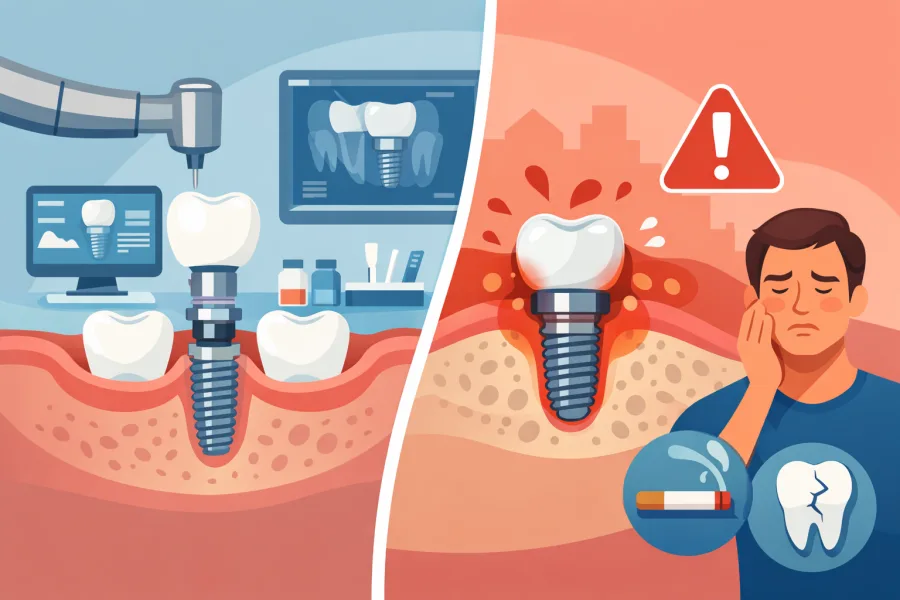
Choosing to invest in dental implants is a major decision for your health, appearance, and quality of life. Because implants represent a significant personal and financial commitment, the thought that an implant might fail or need to be removed can trigger immediate worry.
Here is the reassuring reality backed by decades of clinical data: dental implants have one of the highest success rates in modern medicine, consistently exceeding 95% to 98% when placed by an experienced oral and maxillofacial surgeon. True implant failure is uncommon, and when issues do arise, recognizing the warning signs early allows us to intercept and save the restoration. Here is a clear clinical look at why dental implants fail, how to distinguish between early and late complications, and how we protect your smile long-term.
Early vs. Late Implant Failure: Understanding the Biological Timeline
A dental implant works through a biological marvel called osseointegration, a process where living bone cells fuse directly to the biocompatible titanium surface of the implant post. When failure occurs, it falls into one of two distinct categories based on timing:
- Early Failure (Within the First 3 to 6 Months): This happens before the implant has fully fused with the jawbone. It is typically caused by insufficient initial bone stability, surgical overheating of the bone, micro-movement from chewing on the site too soon, or early bacterial contamination.
- Late Failure (Years After Successful Function): This occurs long after the implant has been fully integrated and restored with a crown. Late failure is almost always caused by two factors: a chronic bacterial gum infection known as peri-implantitis, or continuous excessive mechanical biting pressure from nighttime teeth grinding.
The Warning Signs: When to Seek Immediate Evaluation
Dental implants rarely fail overnight. In the majority of cases, your body gives subtle warning signals before irreversible bone loss occurs:
- Mobility or Wiggle: Unlike natural teeth, which are cushioned by a flexible periodontal ligament, a healthy dental implant is fused directly into solid bone and should feel completely rigid. Any noticeable movement is an immediate red flag. While a loose feeling is sometimes just an abutment screw that needs tightening, it must be evaluated promptly to ensure the implant body itself is intact.
- Peri-Implantitis (Gum Inflammation and Bleeding): Bleeding when brushing, tender swollen red gums, or persistent bad taste around an implant indicates peri-implant mucositis or advanced peri-implantitis. Without prompt clinical treatment, the bacteria will gradually erode the supporting bone.
- Dull Throbbing Pain When Chewing: Mild soreness is expected during initial surgical healing. However, pain that arises months after you have been chewing comfortably suggests active infection or nerve compression.
The Primary Risk Factors and How to Prevent Them
Understanding what jeopardizes implant integration allows you and your surgical team to eliminate risks before surgery even begins:
- Tobacco and Nicotine Use: Smoking and vaping are among the leading statistical causes of implant failure. Nicotine restricts blood vessels, starving healing bone and gum tissue of oxygen and immune cells. Pausing smoking prior to and following surgery dramatically improves integration.
- Inadequate Bone Volume: Placing an implant into a jaw ridge that is too thin or soft compromises primary stability. This is why thorough 3D CBCT scans and preliminary bone grafting or sinus lifts are so vital to long-term success.
- Uncontrolled Bruxism (Teeth Grinding): Heavy clenching places tremendous lateral sheer force on the implant post. Wearing a custom night guard absorbs these forces and shields the bone from micro-fractures.
- Systemic Health Factors: Conditions like uncontrolled Type 2 diabetes or active autoimmune disorders can impair healing. When blood glucose is carefully managed, diabetic patients achieve implant success rates comparable to non-diabetics.
Can a Failed Dental Implant Be Replaced?
If an implant does fail to integrate, it does not mean you can never have a permanent tooth in that location. In fact, second-attempt implant placements boast success rates above 90% when managed with patience and precision:
- Gentle Removal: Your oral surgeon numbs the area completely and uses specialized reverse-torque instruments to remove the loose fixture with minimal bone loss.
- Site Debridement and Grafting: Any inflamed tissue is meticulously cleaned away, and a fresh bone graft is placed to rebuild the socket volume.
- Regeneration Phase: The site is allowed to heal cleanly for 3 to 4 months until fresh, healthy bone has reorganized.
- New Implant Placement: A replacement implant is inserted into the newly reinforced bone, restoring your smile permanently.
Comprehensive Implant Care at OFS Miami
The secret to lifelong dental implant success lies in precise surgical placement and proactive maintenance. At Oral & Facial Surgery of Miami, board-certified oral and maxillofacial surgeon Dr. Johanny Caceres uses state-of-the-art 3D digital guided surgery to plan every implant with sub-millimeter accuracy, minimizing complications and protecting your health.
If you are considering dental implants or have concerns about an existing restoration that feels sensitive or loose, do not wait. Call Oral and Facial Surgery of Miami today at (305) 552-1193 or schedule an evaluation online to protect your smile and investment.