
Upper vs. Lower Wisdom Teeth: Why the Pain Feels Different
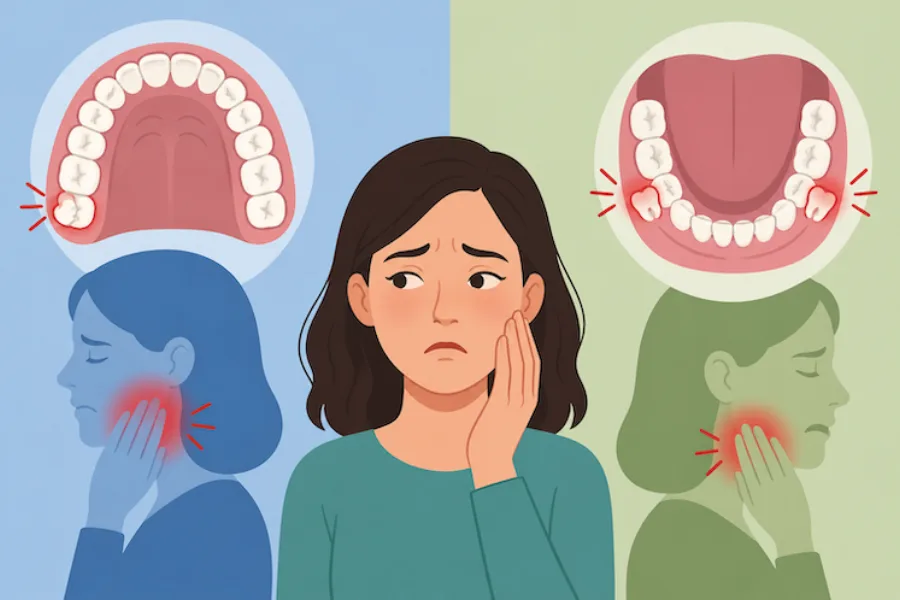
Third molar discomfort is one of the most common complaints evaluated in maxillofacial surgery, yet patients are often bewildered by how differently their upper and lower wisdom teeth behave. While an upper third molar might trigger a vague, dull sinus headache or cheek irritation, an impacted lower wisdom tooth often unleashes sharp, radiating, throbbing agony that shoots through the jawline, neck, and ear.
These contrasting pain profiles are not random; they are directly governed by the contrasting skeletal architecture, neural circuitry, and biological environments of the maxilla (upper jaw) versus the mandible (lower jaw). At Oral and Facial Surgery of Miami in Coral Gables, board-certified oral and maxillofacial surgeon Dr. Johanny Caceres utilizes 3D volumetric diagnostics to decode exactly why your wisdom teeth hurt and execute gentle, precise surgical treatment.
1. Skeletal and Neural Divergence: Maxilla vs. Mandible Anatomy
The human skull accommodates teeth within two vastly different types of bone, creating unique physiological environments for erupting molars:
- The Maxillary Architecture (Upper Jaw): The upper jaw consists of highly vascular, sponge-like cancellous bone with a thin cortical shell. Upper third molars erupt immediately beneath the floor of the maxillary sinus cavity. The sensory innervation of the upper teeth stems from the posterior superior alveolar nerves, which branch off the maxillary division (V2) of the trigeminal nerve.
- The Mandibular Architecture (Lower Jaw): The lower jaw is a dense, thick, heavily calcified cortical plate designed to withstand intense chewing forces. Lower third molars develop inside this rigid, unyielding bone. In addition, lower teeth are innervated by the substantial inferior alveolar nerve trunk, which travels through a rigid bony canal directly beneath, and frequently touching, the roots of the lower wisdom teeth.
- Bone Density Impact on Inflammation: When an upper tooth becomes inflamed, the porous maxillary bone permits fluid to dissipate relatively easily into surrounding soft tissues or the sinus. In the lower jaw, dense cortical plates trap inflammatory exudate and swelling within confined bone, generating high hydrostatic pressure that directly compresses sensory nerve fibers.
2. Pain Profiles: Diffuse Sinus Pressure vs. Sharp Neuropathic Radiance
Because of these anatomical differences, upper and lower wisdom teeth present with distinctly different symptom patterns:
Upper wisdom tooth pain is typically diffuse, dull, and positional. Because roots frequently expand directly against the thin sinus floor, patients often misinterpret upper molar inflammation as a seasonal sinus infection, reporting a heavy feeling in the cheekbones, pressure behind the eyes, and dull temporal headaches that intensify when bending over. In addition, because upper third molars often erupt with a buccal (outward) flare, their sharp cusps frequently bite into the delicate buccal mucosa of the inner cheek, causing painful traumatic ulcers.
Lower wisdom tooth pain, by contrast, is notoriously intense, localized, and acute. Lower third molars are the most frequently impacted teeth in the human mouth. When a lower molar erupts partially at an angle, the overlying gum tissue creates a tight flap (operculum) that traps food and oral bacteria. This triggers pericoronitis, an aggressive infection marked by severe trismus (inability to open the mouth), throat pain upon swallowing, and swelling in the submandibular lymph nodes. If the root directly compresses the inferior alveolar nerve canal, patients experience sharp, electric, shooting pain that radiates across the jawline, chin, and temporal region.
3. Upper vs. Lower Wisdom Teeth: Clinical Comparison Table
Comparing the biological, surgical, and recovery profiles of upper and lower wisdom teeth highlights why management strategies differ:
| Clinical Characteristic | Upper Wisdom Teeth (Maxillary) | Lower Wisdom Teeth (Mandibular) |
|---|---|---|
| Dominant Pain Sensation | Dull ache, sinus pressure, cheek ulceration from biting | Sharp throbbing, trismus, radiating jawline and ear pain |
| Adjacent Vital Anatomy | Maxillary sinus cavity and pterygomaxillary space | Inferior alveolar nerve canal and lingual nerve sheath |
| Frequency of Impaction | Lower (frequently erupts buccally or vertically) | Extremely high (mesioangular, horizontal, or full bony) |
| Surgical Extraction Effort | Typically faster due to softer, pliable cancellous bone | Requires bone troughing and precise tooth sectioning |
| Alveolar Osteitis (Dry Socket) Risk | Extremely rare (under 1% due to superior vascular supply) | Significantly higher (3% to 5% baseline, higher in smokers) |
4. Chairside Diagnostics and Gentle Surgery with Dr. Johanny Caceres
Because upper and lower third molars present fundamentally different anatomical hazards, treating them requires individualized surgical planning. At our practice, Dr. Johanny Caceres evaluates every patient using low-dose 3D Cone Beam Computed Tomography (CBCT). This advanced imaging provides clear answers before surgery begins:
- Upper Molar Sinus Mapping: For maxillary third molars, Dr. Caceres determines whether root apices penetrate the Schneiderian sinus membrane. If a sinus communication risk exists, she utilizes specialized atraumatic extraction techniques to protect sinus integrity.
- Lower Molar Nerve Clearance: For mandibular third molars, 3D imaging reveals the exact course of the inferior alveolar nerve. When roots wrap directly around the canal, Dr. Caceres can perform a nerve-sparing coronectomy to completely eliminate paresthesia risk.
- Outpatient Sedation Protocols: Whether you need one problematic lower molar removed or all four third molars addressed in a single visit, our Coral Gables surgical suite provides deep intravenous sedation to ensure you sleep peacefully through your entire procedure.
Do not wait for wisdom tooth pain to disrupt your life. Contact Oral and Facial Surgery of Miami at (305) 552-1193 or book your consultation online today for precise, compassionate surgical care.