
When a Tooth Can’t Be Saved?
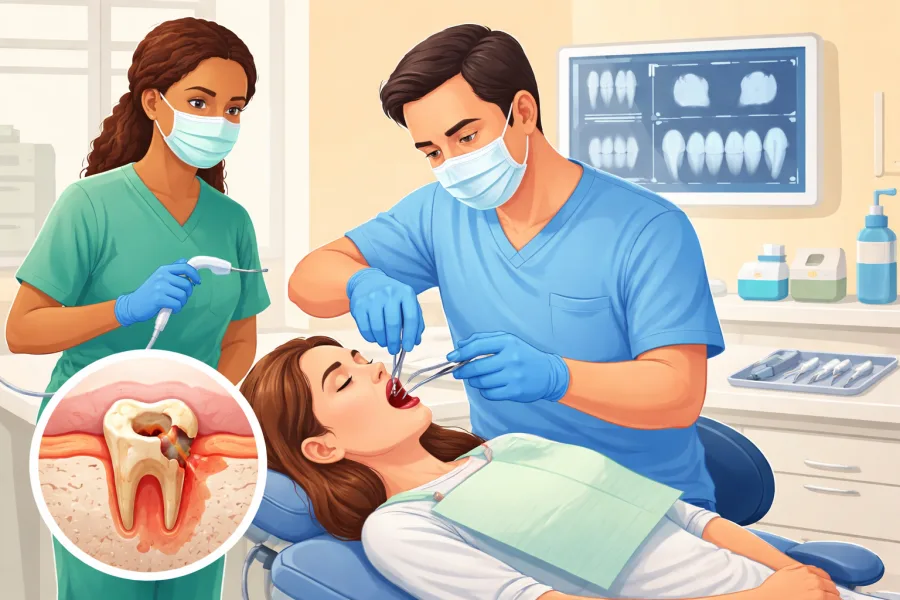
Hearing from a dental professional that a tooth cannot be saved is difficult news for any patient to process. Natural teeth are engineered to withstand decades of chewing forces, and modern dentistry offers an extraordinary array of restorative procedures designed to preserve them, from composite bonding to endodontic root canals and porcelain crowns. However, there are definitive biological, anatomical, and biomechanical thresholds beyond which attempting to save a tooth is no longer clinically feasible or safe.
At Oral and Facial Surgery of Miami, board-certified oral and maxillofacial surgeon Dr. Johanny Caceres evaluates non-restorable teeth every day. Recognizing the clear clinical criteria that designate a tooth as non-restorable and understanding how surgical extraction paired with modern dental implants restores lifelong dental wellness empowers South Florida patients to navigate their care with confidence.
Biological Criteria: Severe Subgingival Decay and Lack of Ferrule
A tooth requires a specific amount of healthy, sound dentin above the alveolar bone crest to support a long-lasting restorative crown. This band of healthy tooth structure, clinically known as the ferrule, must measure at least 1.5 to 2.0 millimeters in height around the entire circumference of the tooth. When deep bacterial decay extends subgingivally beneath the bone crest, this essential ferrule is lost.
Attempting to place a crown without an adequate ferrule causes the restoration to leverage against the brittle root during chewing, leading to rapid crown dislodgement, recurrent microleakage, or catastrophic root fracture. While crown lengthening surgery can sometimes expose additional tooth structure, doing so in areas with limited bone support compromises adjacent teeth, making surgical extraction the more predictable, responsible treatment choice.
Structural Failures: Vertical Root Fractures and Bone Loss
Another common reason a tooth cannot be saved is a vertical root fracture. Unlike minor enamel chips, a vertical root fracture is a complete structural split that begins in the root and travels upward along the long axis of the tooth toward the crown. Because bacteria colonize the entire fracture line within hours, a vertical root fracture creates a chronic, non-healing periodontal defect in the jawbone. No adhesive cement or surgical intervention can seal a vertical root split; the tooth is hopeless and must be extracted immediately to halt bone loss.
Similarly, severe generalized or localized periodontitis can destroy the supporting alveolar bone socket. When bone resorption reaches the apical third of the root or invades the furcation between molar roots, the tooth loses all functional stability. Teeth with Class III mobility cannot withstand chewing pressure and act as persistent bacterial reservoirs that threaten overall systemic health, necessitating surgical removal.
| Clinical Condition | Pathological Mechanism | Why the Tooth Cannot Be Saved | Optimal Replacement Solution |
|---|---|---|---|
| Subgingival Caries Below Bone | Decay destroys cervical dentin beneath the alveolar crest | Insufficient ferrule height to support a permanent crown | Surgical extraction with immediate dental implant |
| Vertical Root Fracture | Structural longitudinal crack propagating through the root | Cannot be sealed; harbors chronic bone-destroying infection | Surgical tooth removal and socket preservation graft |
| Severe Class III Mobility | Advanced periodontitis resorbing over 70% of alveolar bone | Complete loss of periodontal ligament anchorage | Extraction, ridge augmentation, and implant therapy |
| Internal / External Root Resorption | Aggressive osteoclasts dissolve root structure internally | Perforates root canal walls beyond endodontic repair | Atraumatic surgical extraction and implant crown |
Atraumatic Surgical Extraction and Socket Preservation
When a tooth is deemed non-restorable, removing it quickly and atraumatically is essential to preserve the surrounding alveolar ridge for future tooth replacement. Traditional extraction methods that aggressively rock teeth side to side can fracture thin buccal bone plates, complicating future implant placement.
Oral and maxillofacial surgeons utilize specialized periotomes and surgical sectioning techniques to deliver the roots gently along their natural path of withdrawal without damaging cortical bone. Immediately following extraction, socket preservation grafting is performed. By placing specialized bone mineral particles and a collagen barrier membrane into the empty socket, the surgeon prevents the jawbone from collapsing, preserving ideal height and width for a permanent dental implant.
Restoring Your Smile with Dental Implants in Coral Gables
Losing a natural tooth does not mean living with a gap in your smile or compromising your chewing ability. Modern dental implants represent the gold standard in tooth replacement, offering aesthetics, bite force, and biological stability that match natural dentition. In many clinical scenarios, an immediate dental implant can be placed into the fresh extraction socket during the very same surgical visit.
At Oral and Facial Surgery of Miami, Dr. Johanny Caceres uses high-resolution 3D imaging and outpatient IV twilight sedation to make extractions and implant reconstructions completely comfortable and painless. If you have a compromised tooth causing pain or have been told a tooth is non-restorable, contact our surgical team at (305) 552-1193 or request an appointment online.