
Are Wisdom Teeth Genetic? What Families Should Know
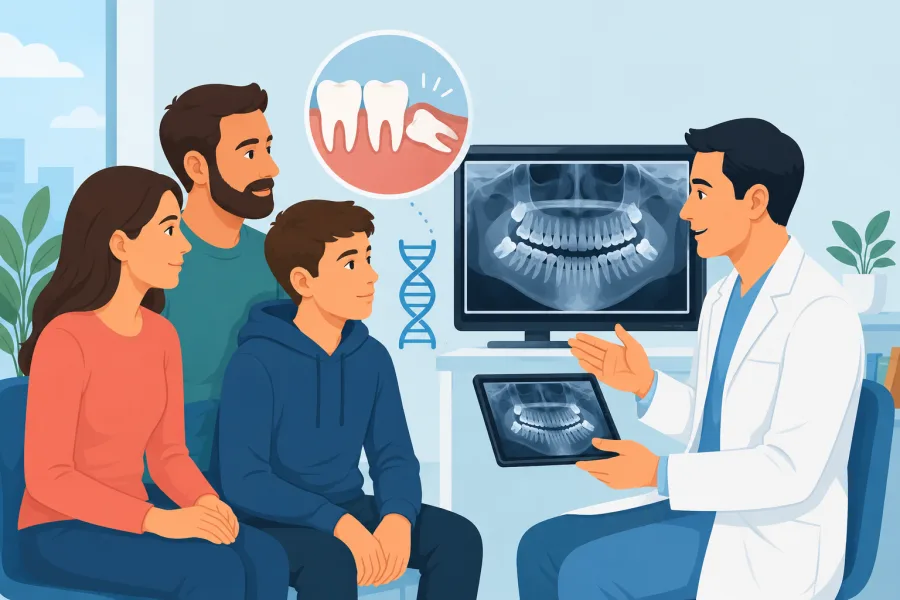
When parents sit down in our consultation rooms, a common question arises: "If both my spouse and I had severe, impacted wisdom teeth, will our teenager experience the exact same problem?" Conversely, some patients wonder why their siblings developed four third molars while they never formed a single one. Third molar development, positioning, and eruption mechanics are deeply rooted in hereditary genetics, evolutionary changes, and familial skeletal anatomy.
At Oral & Facial Surgery of Miami, board-certified oral and maxillofacial surgeon Dr. Johanny Caceres evaluates multi-generational patterns of dental crowding and third molar impaction. Understanding how genetics dictate jaw dimensions, tooth bud initiation, and angulation provides parents and young adults with valuable foresight into their oral health.
1. Evolutionary Genetics: The Reduction of Human Jaw Dimensions and Third Molar Agenesis
To understand why wisdom teeth so frequently run into complications today, we must examine human evolutionary biology. Early hominids possessed broad, robust jaws and heavy dental arches designed to chew raw, fibrous vegetation, roots, and tough uncooked meats. Third molars provided vital occlusal surface area and served as natural replacements when first or second molars broke or experienced severe attrition.
With the advent of controlled fire, cooking, and agricultural food processing, human dietary needs shifted dramatically. Softer diets placed far less mechanical strain on developing masticatory bones. Over hundreds of thousands of years, natural selection favored smaller, lighter craniofacial skeletons with reduced facial prognathism (jaw protrusion). However, while skeletal jaw dimensions decreased steadily, the genetic instructions governing tooth quantity (32 permanent teeth) evolved at a slower rate.
Interestingly, genetic third molar agenesis (congenital absence of one or more wisdom teeth) is one of the most common micro-evolutionary mutations in modern humans. Research shows that variants in genes such as PAX9 and MSX1 frequently disrupt the dental lamina signaling pathways that initiate third molar tooth buds. As a result, approximately 20 to 35 percent of modern humans naturally fail to develop at least one wisdom tooth, a hereditary trait that passes seamlessly from parents to children.
2. Inherited Phenotypes: Arch Length Discrepancies and Familial Impaction Patterns
A person inherits genetic material from both parents, often receiving a complex blend of physical characteristics. A child may inherit their father's larger tooth crowns alongside their mother's petite mandibular arch length. This mismatch creates an arch-length deficiency: the dental arches simply lack sufficient linear space along the alveolar ridge to accommodate four additional large molars.
Familial genetics also strongly dictate the angulation of developing tooth buds. If parents experienced horizontal or mesioangular bony impactions, their offspring have a significantly higher probability of developing third molars that tilt forward into neighboring second molars or transverse across the mandible. Dense cortical bone thickness and the vertical height of the mandibular ramus are similarly inherited skeletal traits that determine whether a wisdom tooth will erupt vertically or remain trapped beneath bone and gum tissue.
| Biological Factor | Genetic Influence | Clinical Manifestation in Patients |
|---|---|---|
| Tooth Bud Formation | High; controlled by PAX9, MSX1, and AXIN2 gene expression | Congenital absence (agenesis) of 1 to 4 wisdom teeth across family lines |
| Skeletal Jaw Dimensions | High; mandibular length and retromolar space are polygenic traits | Small jaw phenotype causing universal lack of space for eruption |
| Tooth Crown Size | High; mesiodistal crown widths inherit directly from parents | Disproportionately large molar crowns causing crowded impactions |
| Masticatory Muscle Tone | Moderate; diet and clenching habits influence bone density | Heavy nocturnal bruxism aggravating pericoronitis and jaw fatigue |
| Cystic Susceptibility | Moderate; epithelial rests of Malassez react to chronic impaction | Higher propensity for dentigerous cysts in retained unerupted follicles |
3. Environmental and Epigenetic Influences: Diet, Mastication, and Craniofacial Growth
While genetics establish the primary blueprint for your facial bones and dentition, environmental factors influence how that blueprint is expressed. Craniofacial biology demonstrates that bone remodels in response to mechanical loading (Wolff's law). During childhood and adolescence, chewing firm, textured foods stimulates robust transverse jaw growth and expands the dental arches.
In contemporary societies, diets dominated by highly processed, soft foods reduce physiological chewing forces. This functional disuse can stunt full alveolar development, turning what might have been borderline space into a definitive impaction. Additionally, childhood habits such as mouth breathing, persistent allergic rhinitis, and tongue-thrust swallowing patterns alter facial muscle dynamics, narrowing the upper maxilla and further restricting the space available for erupting third molars.
4. Family Screening Timelines, Precision 3D Imaging, and Coral Gables Care
Because wisdom tooth complications frequently mirror patterns seen in older siblings or parents, proactive family screening is the gold standard of care. Waiting for a teenager to develop acute facial swelling, throbbing pain, or pericoronitis often means treating an infection after root development is complete, when surgical extraction carries longer recovery periods and closer proximity to the inferior alveolar nerve.
The American Association of Oral and Maxillofacial Surgeons recommends an initial third molar evaluation between ages 15 and 18. At Oral & Facial Surgery of Miami, Dr. Johanny Caceres uses low-dose 3D Cone Beam Computed Tomography (CBCT) to track tooth bud maturation, root formation, and spatial trajectory before roots fuse with dense bone. Removing problematic third molars during late adolescence, while root tips are only one-third to two-thirds formed, provides the quickest healing, easiest bone regeneration, and lowest risk profile.
Whether wisdom tooth trouble is a familiar pattern in your family or you want to verify if your child has naturally missing molars, our surgical team is here to guide you. Contact Oral & Facial Surgery of Miami today at (305) 552-1193 or book your consultation online for expert evaluation and peace of mind.