
The Hidden Risks of Ignoring Wisdom Tooth Pain
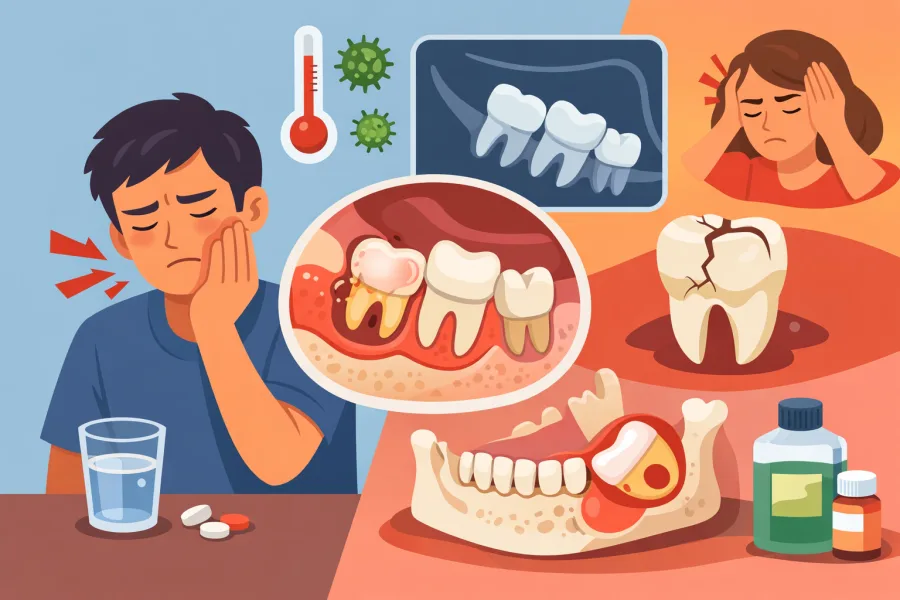
Wisdom tooth discomfort often starts innocently. You might feel a dull pressure at the back of your jaw, occasional tenderness when chewing, or a minor gum flare-up that subsides after a few days of warm salt water rinses. Because the pain comes and goes, it is easy to assume the problem resolved on its own. Unfortunately, with third molars, silence does not equal safety. When a wisdom tooth stops hurting, it rarely means it has found room to grow; more often, it is silently compromising your surrounding bone, nerves, and adjacent teeth.
Postponing an oral surgery evaluation turns a routine 20-minute procedure into a complex reconstructive challenge. Here are the hidden biological risks of ignoring wisdom tooth pain and why timely treatment protects your long-term oral health.
1. The False Security of Intermittent Symptoms
Patients frequently delay scheduling an extraction because third molar pain is notoriously episodic. Understanding the biological cycle of impaction explains why symptoms fluctuate:
- The Eruption and Dormancy Cycle: Human jawbones finish their forward growth around age 18, leaving little to no room for four large third molars. As a wisdom tooth attempts to emerge, it exerts pressure against the dense cortical bone, triggering an acute inflammatory flare. When the tooth exhausts its eruptive force, inflammation temporarily dips, giving you a false sense of security while the physical obstruction remains unchanged.
- The Retromolar Anatomy: The tissue behind your second molars (the retromolar pad) is thick, fibrous, and difficult to reach with a toothbrush or dental floss. Bacteria accumulate in this dark, anaerobic recess, establishing chronic subclinical inflammation that quietly erodes periodontal attachment over months and years.
2. Irreversible Structural Damage: Second Molar Resorption and Jaw Cysts
The most devastating consequence of ignoring wisdom tooth pain is that the damage rarely stays confined to the wisdom tooth itself. Impacted third molars frequently destroy healthy, vital teeth:
| Hidden Complication | Pathological Mechanism | Early Warning Signs | Consequences of Delay |
|---|---|---|---|
| Second Molar Root Resorption | Wisdom tooth pushes horizontally into the root of the adjacent second molar, activating osteoclasts that dissolve root dentin. | Cold sensitivity or mild ache in the second molar; frequently zero symptoms until structural integrity is lost. | Irreversible loss of both the wisdom tooth and the functional second molar, necessitating bone grafting and dental implants. |
| Dentigerous Cysts | The developmental sac surrounding the impacted crown fills with fluid, expanding into a hollow lesion inside the jawbone. | Painless bone expansion; visible only on panoramic dental X-rays or 3D CBCT scans in early stages. | Hollows out large sections of the mandible, weakens jaw structural integrity, and increases spontaneous fracture risk. |
| Interproximal Decay | A tight, inaccessible food trap forms between the tilted wisdom tooth and the distal neck of the second molar. | Food packing between molars; foul odor or unpleasant taste after flossing. | Deep cervical root caries that cannot be filled traditionally, requiring root canals, crown lengthening, or extraction. |
| Deep Fascial Cellulitis | Anaerobic bacteria penetrate through the thin lingual cortex into the submandibular and lateral pharyngeal neck spaces. | Progressive facial swelling, fever, difficulty opening mouth (trismus), painful swallowing. | Life-threatening airway compromise requiring hospital admission, emergency surgical incision, and drainage. |
External root resorption is particularly insidious. When a lower wisdom tooth grows horizontally (at a 90-degree angle), its crown presses directly against the cervical root of the healthy second molar in front of it. Over time, the chronic pressure activates cellular resorption, eating away the healthy root structure like a slow-moving cavity below the gumline. In countless cases, by the time a patient finally seeks treatment for severe pain, the second molar has been destroyed beyond repair, turning a single extraction into the loss of two molars.
3. From Local Pericoronitis to Spreading Fascial Infection
When a wisdom tooth partially breaches the gumline, it leaves a flap of tissue called an operculum. This flap acts as a one-way valve: food and bacteria easily slide underneath, but saliva, toothbrushes, and floss cannot clean them out.
What starts as a localized gum infection (pericoronitis) can escalate into a systemic medical emergency:
- Trismus and Muscle Spasms: As infection spreads into the pterygomandibular space and masseter muscle, opening your mouth wider than one or two centimeters becomes excruciatingly painful.
- Deep Fascial Space Infection: The inner lingual bone near lower wisdom teeth is paper-thin. Bacteria can break through this barrier and descend into the submandibular and parapharyngeal spaces of the neck, threatening the airway (Ludwig's angina).
- Systemic Sepsis: Bacteria from an untreated dental abscess can enter your bloodstream, elevating inflammatory markers, straining the heart, and producing systemic illness.
4. Why Early Action Matters: Care with Dr. Johanny Caceres
There is a definitive surgical window of opportunity for third molar removal. Extracting wisdom teeth in your late teens or early twenties is dramatically simpler, safer, and faster to heal from:
- Incompletely Formed Roots: In young adults, wisdom tooth roots are only one-half to two-thirds formed, sitting far away from the inferior alveolar nerve canal. After age 25, roots elongate into dense hooks and wrap closely around nerve pathways.
- Pliable Jawbone: Youthful bone is elastic and remodels rapidly, allowing smooth atraumatic extraction with minimal post-operative swelling and virtually zero dry socket risk.
- Preventing Collateral Damage: Removing third molars proactively preserves the bone density, periodontal ligaments, and enamel of your functional second molars.
At our practice, Dr. Johanny Caceres is a board-certified oral and maxillofacial surgeon specializing in preventative and complex third molar extractions. Utilizing advanced 3D Cone-Beam CT imaging and outpatient IV sedation in our surgical center, Dr. Caceres ensures that every procedure is comfortable, precise, and completely stress-free.
To learn more about related third molar risks, explore our detailed guides on wisdom tooth cysts and jaw lesions, understanding how oral infections become dangerous, and identifying warning signs of serious wisdom tooth infections.
Do not wait until a minor ache turns into an irreversible dental emergency. Contact our Coral Gables practice at (305) 552-1193 or schedule your comprehensive consultation online through our appointment reservation portal.