
Wisdom Teeth Problems That May Lead to Serious Cysts
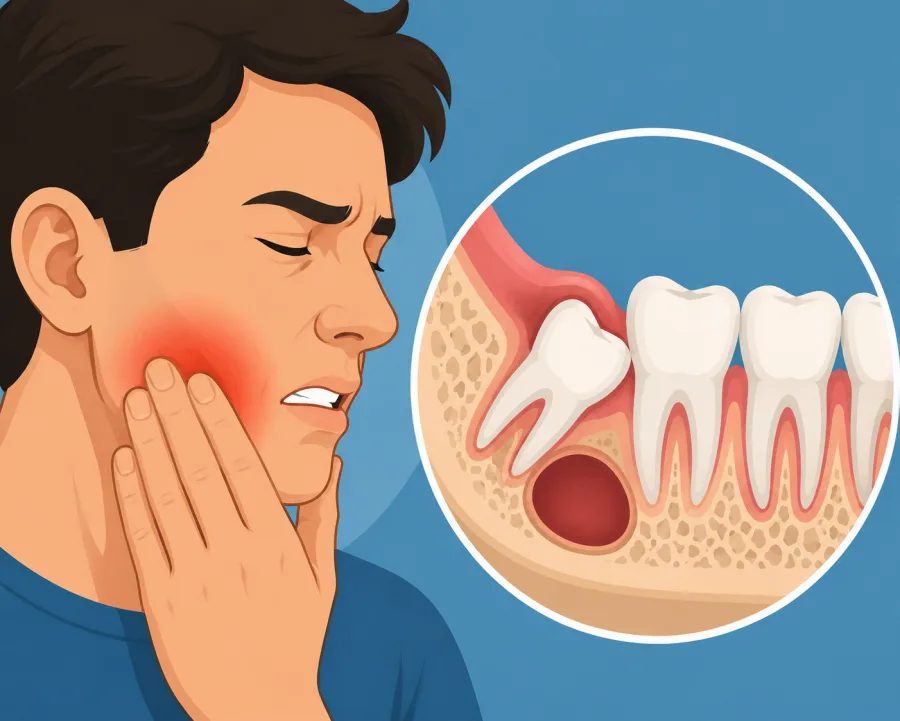
When patients envision wisdom teeth complications, they usually picture sudden agony, localized gum swelling, or food wedged painfully behind second molars. But one of the most deceptive and structurally destructive complications develops silently deep inside the jawbone: the formation of odontogenic cysts around impacted third molars. Because these fluid-filled sacs expand without pain for months or even years, patients rarely suspect a problem until extensive bone loss, neighboring tooth displacement, or nerve compression has already occurred.
Understanding why cysts form around unerupted teeth, recognizing late-stage warning signs, and knowing how oral and maxillofacial surgeons safely remove them preserves the structural integrity of your facial skeleton and prevents complex reconstructive emergencies.
The Silent Expansion: How Dentigerous Cysts Form Around Impacted Molars
Every developing tooth forms inside a protective microscopic envelope known as the dental follicle. When a normal tooth erupts into the dental arch, this follicular sac naturally shrinks, dissolves, and gives way to healthy gingival collar tissue.
When a wisdom tooth becomes impacted (blocked from erupting by dense mandibular bone, thick gingival tissue, or the roots of the adjacent molar), that developmental sac remains trapped. Over time, fluid secreted by the reduced enamel epithelium accumulates inside the closed capsule. As hydrostatic pressure builds, the follicle inflates like a water balloon around the anatomical crown of the tooth.
This lesion is clinically classified as a dentigerous cyst, the second most common type of odontogenic jaw cyst. Because the fluid exerts constant, gentle outward pressure on the surrounding medullary bone, the body's osteoclasts resorb and dissolve healthy jawbone to make room for the growing sac. Because this resorption occurs beneath intact mucosal surfaces without initial infection or acute pressure, you feel no pain while your jawbone steadily hollows out.
Warning Signs and Pathology: Why Asymptomatic Cysts Become Structural Threats
Early-stage dentigerous cysts are almost universally asymptomatic. Most are uncovered by surprise during routine panoramic radiographs or cone beam computed tomography (CBCT) scans taken for orthodontic planning or general dental evaluations.
However, if left unmonitored and untreated, the cyst expands along paths of least resistance through the spongy interior of the mandible. As the lesion reaches substantial dimensions, serious clinical issues arise:
- Mandibular Bone Thinning and Pathological Fractures: A large cyst can erode through the thick cortical plate of the lower jaw, turning a solid bone into an eggshell-thin shell. In severe cases, minor physical trauma, such as chewing hard food or sustaining an incidental bump, can cause a sudden pathological jaw fracture.
- Damage to Adjacent Second Molars: As the cyst balloons forward, its expansive pressure pushes against the roots of healthy second molars. This chronic hydraulic pressure can cause external root resorption, destroying the foundation of irreplaceable functional teeth or tilting them out of occlusion.
- Inferior Alveolar Nerve Compression: The main sensory nerve supplying sensation to your lower lip, chin, and teeth (the inferior alveolar nerve) runs directly beneath the wisdom tooth roots in the mandibular canal. A massive cyst can displace or compress this nerve bundle, causing persistent tingling, numbness, or altered sensation (paresthesia).
- Secondary Bacterial Infection: If bacteria from the oral cavity penetrate the cyst through a micro-perforation in the gum tissue, the sterile fluid turns into an acute abscess. Patients experience sudden severe throbbing, intense facial swelling, trismus (inability to open the jaw), and systemic fever.
Surgical Management: Enucleation, Marsupialization, and Jaw Reconstruction
Treating a wisdom tooth cyst requires a delicate surgical approach designed to eradicate the pathology, protect surrounding nerves, and rebuild damaged bone:
- Cyst Enucleation and Extraction: For small to moderate cysts, the oral and maxillofacial surgeon carefully extracts the impacted third molar while peeling the entire epithelial lining away from the surrounding bone cavity in one intact piece. Removing every microscopic fragment of the cyst wall is essential to eliminate any risk of recurrence.
- Histopathological Biopsy: Every excised cyst is immediately sent to an oral pathology laboratory for microscopic analysis. This confirms that the lesion is a benign dentigerous cyst rather than a more aggressive condition with identical radiographic features, such as an odontogenic keratocyst (OKC) or an ameloblastoma.
- Marsupialization or Decompression: When an expansive cyst envelops the entire angle of the jaw or touches the inferior alveolar nerve, aggressive enucleation might risk fracturing the jaw or tearing the nerve. In these complex scenarios, the surgeon performs decompression, creating a surgical window to continuously drain fluid and relieve interior pressure. Over six to twelve months, the surrounding jawbone fills in and the cyst shrinks drastically, allowing safe, definitive removal during a minor second stage.
- Bone Grafting: Once the cyst is excised, a significant osseous void often remains in the mandible. Placing a specialized dental bone graft restores solid mandibular density, stabilizes adjacent teeth, and prevents long-term skeletal collapse.
Precision 3D Diagnostics and Treatment with Dr. Johanny Caceres in Coral Gables
Managing jaw cysts requires advanced surgical imaging and hospital-level operative skill. At our practice, board-certified oral and maxillofacial surgeon Dr. Johanny Caceres utilizes state-of-the-art in-office 3D CBCT imaging to map out cyst boundaries, evaluate cortical thickness, and trace the precise trajectory of the inferior alveolar nerve in sub-millimeter detail.
Whether you are dealing with unexplained jaw discomfort, a cystic shadow identified on your routine dental X-ray, or impacted wisdom teeth that require safe preventive extraction, our surgical team offers comfortable IV sedation and gentle, expert care.
Protect your jawbone and long-term oral health before silent complications escalate. Call our Coral Gables office directly at (305) 552-1193 or book your consultation online today.