
Horizontal Wisdom Teeth: What It Means and Treatment Options
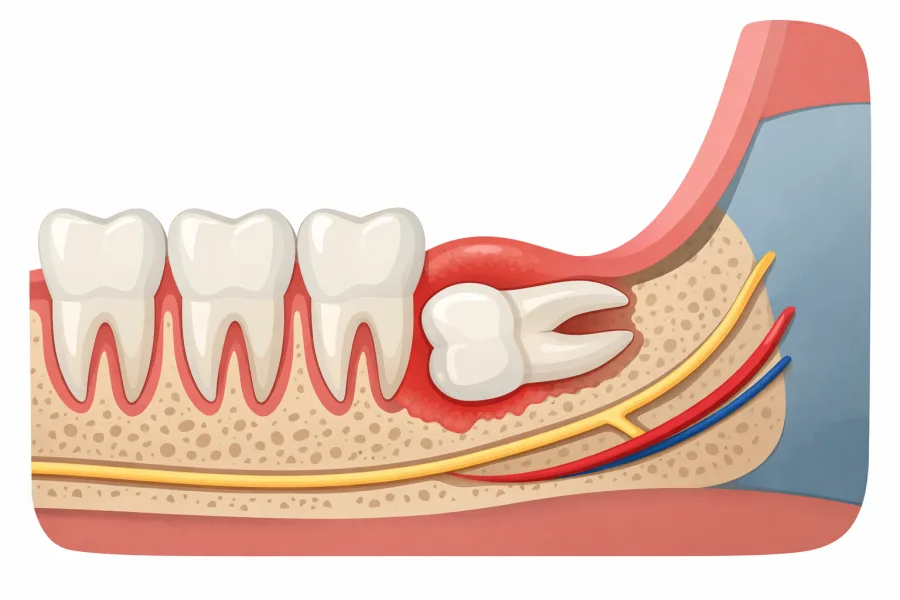
During a routine dental checkup or after an episodic jaw ache, your dentist reviews your panoramic X-ray and delivers unexpected news: your wisdom tooth is lying completely on its side. Hearing that you have a "horizontal wisdom tooth" can sound alarming. Instead of erupting upward toward the chewing plane like a normal tooth, a horizontally impacted third molar has turned 90 degrees, pointing its crown directly into the root of your neighboring second molar.
Because horizontally impacted wisdom teeth are locked beneath the gumline and surrounded by dense jawbone, they will never correct their orientation on their own. Left untreated, this sideways positioning poses significant risks to your entire dental arch. Here is what horizontal impaction means biologically, how oral surgeons remove them safely, and why early treatment protects your smile.
1. Anatomical Classification: Understanding the 90-Degree Impaction
In oral and maxillofacial surgery, third molar impactions are categorized using Winter's Classification and the Pell and Gregory System, which evaluate the spatial relationship of the tooth relative to the jawbone and the adjacent molars:
- Vertical Impaction: The tooth is oriented in a normal upright position but remains trapped beneath gum tissue or dense bone due to lack of space in the dental arch.
- Mesioangular Impaction: The most common form of impaction, where the tooth tilts forward at a 45-degree angle toward the front of the mouth.
- Distoangular Impaction: The tooth tilts backward toward the ascending ramus of the jawbone, often wedging its roots close to neighboring structures.
- Horizontal Impaction: The tooth lies completely parallel to the jawline at a 90-degree angle. The chewing surface of the crown rams directly into the roots of the second molar, while its roots extend backward into the mandibular bone.
Horizontal impactions occur almost exclusively in the lower jaw (mandible). Because the human jaw has evolved to be shorter and more compact than those of our evolutionary ancestors, modern dental arches frequently run out of room before the third molars can orient themselves vertically.
| Impaction Angle | Spatial Orientation | Clinical Risk Profile | Primary Surgical Approach |
|---|---|---|---|
| Vertical | Upright orientation; fails to emerge through gingival tissues. | Pericoronal gum flap infection; food stagnation; manageable extraction. | Simple surgical flap elevation and elevator delivery. |
| Mesioangular | Angled forward at roughly 45 degrees against the second molar crown. | Interproximal caries; chronic gum inflammation; moderate bone loss. | Crown sectioning and sequential root elevation. |
| Horizontal | Lies entirely on its side (90 degrees) pushing into second molar roots. | Severe root resorption of adjacent molar; deep bone destruction; dentigerous cysts. | Surgical osteotomy, multi-planar tooth sectioning, and nerve preservation. |
| Distoangular | Angled backward into the mandibular ramus and ascending bone. | Deep bone entrapment; difficult surgical access; close proximity to mandibular canal. | Extensive bone troughing and specialized micro-instrument delivery. |
2. The Destructive Impact on Neighboring Second Molars
A common question patients ask is: "If my horizontal wisdom tooth doesn't hurt, why can't I just leave it alone?" The danger of a horizontal wisdom tooth lies in its silent destruction of adjacent structures:
- External Root Resorption: As the horizontal crown continues its biological drive to erupt, it exerts constant mechanical pressure against the root trunk of your permanent second molar. This pressure stimulates cellular osteoclasts, which literally dissolve the protective cementum and dentin of the second molar root. By the time symptoms appear, the second molar root may be hollowed out, requiring root canal therapy or complete extraction.
- Untreatable Periodontal Defects: A horizontal tooth creates a deep, narrow crevice along the back of the second molar. This area becomes an anaerobic bacteria trap that cannot be cleaned by toothbrushes or professional dental instruments, leading to progressive bone loss that weakens the second molar's foundation.
- Cyst and Tumor Formation: Every unerupted tooth is enveloped in a microscopic developmental sac called the dental follicle. In horizontal impactions, this tissue can fill with fluid, expanding into a dentigerous cyst or odontogenic tumor that hollows out the jawbone.
3. The Surgical Protocol: Precision Sectioning and Nerve Safety
Horizontally impacted teeth cannot simply be grasped with forceps and pulled out. Because the tooth is anchored on its side beneath dense bone, attempting to force it out intact would fracture the jawbone or damage adjacent roots. Oral and maxillofacial surgeons employ a delicate, minimally invasive micro-surgical sequence:
- High-Resolution 3D CBCT Evaluation: Before surgery, a 3D Cone-Beam CT scan maps the precise 3D trajectory of your inferior alveolar nerve canal relative to the horizontal tooth roots. If the roots wrap directly around the nerve, your surgeon may discuss a coronectomy (removing the crown to eliminate pressure while leaving harmless root tips in place).
- Outpatient IV Sedation: You sleep comfortably under twilight IV sedation, unaware of the procedure and experiencing zero pain or anxiety.
- Conservative Bone Access: A tiny, precise incision is made along the gumline, and a small window of cortical bone is gently removed with continuous chilled saline irrigation to keep the bone cool and healthy.
- Odontotomy (Tooth Sectioning): The surgeon carefully sections the tooth into smaller, puzzle-like pieces: first separating the crown from the roots, and then gently dividing the roots. Each small fragment is lifted out atraumatically without placing pressure on the second molar or mandibular nerve.
- Primary Closure: The surgical site is thoroughly flushed with sterile saline and closed with dissolvable sutures that disappear naturally over 7 to 10 days.
4. Recovery Roadmap and Comprehensive Care with Dr. Johanny Caceres
Because modern surgical techniques prioritize conservative bone removal, recovery from horizontal wisdom tooth extraction is smooth and predictable:
- Days 1 to 3: Facial swelling reaches its biological peak at 48 hours. Apply cold packs to your cheeks for 20 minutes on and 20 minutes off, sleep with your head elevated on two pillows, and stick to a high-protein liquid diet (smoothies, purees, Greek yogurt; no straws).
- Days 4 to 7: Swelling softens and recedes. Transition to soft, easy-to-chew foods like scrambled eggs, mashed potatoes, and pasta. Begin gentle warm salt water rinses after meals to keep the surgical sites clean.
- Week 2 Onward: Incision sites heal, jaw flexibility returns to normal, and you can resume regular physical exercise.
At our practice, Dr. Johanny Caceres, a board-certified oral and maxillofacial surgeon, provides expert care for complex horizontal, mesioangular, and deeply impacted wisdom teeth. our surgical facility combines advanced 3D imaging with compassionate, personalized surgical care to protect your smile and ensure rapid healing.
To learn more about impaction types and surgical recovery, read our clinical guides on partial versus fully impacted wisdom teeth, understanding sideways wisdom teeth expectations, and our protocols for nerve preservation in third molar surgery.
If you have been diagnosed with a horizontal wisdom tooth or are experiencing jaw tenderness, schedule your evaluation today. contact Oral and Facial Surgery of Miami directly at (305) 552-1193 or reserve your appointment online through our consultation booking page.