
Can Wisdom Teeth Cause Ear Pain?
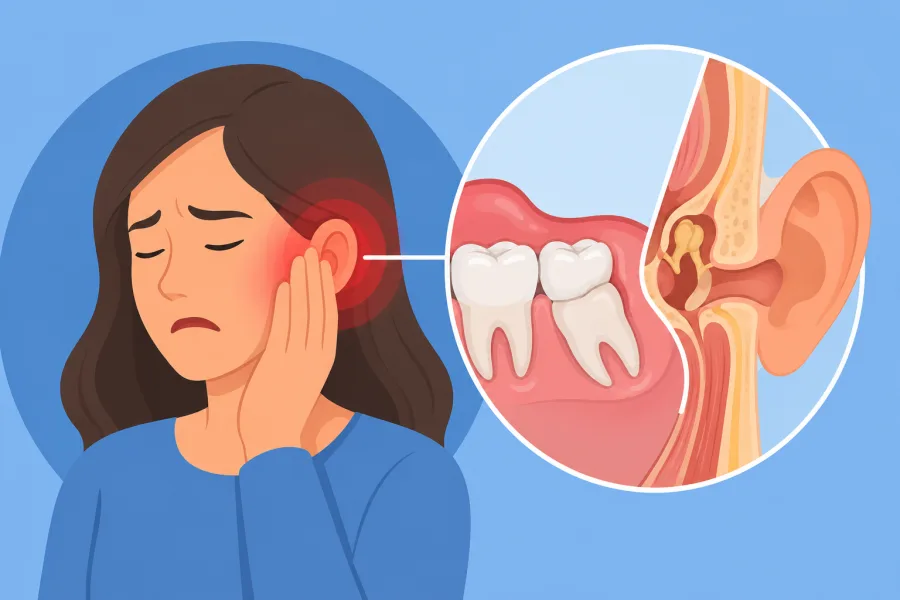
Waking up with a deep, throbbing ache inside your ear often sends you straight to an urgent care clinic or an ear, nose, and throat (ENT) specialist. You expect to hear that you have swimmer's ear or an acute middle ear infection, only to be told that your ear canal and eardrum look completely normal. If antibiotic ear drops have failed to resolve your pain and you also notice stiffness along the back of your jaw, the true culprit is often sitting right at the back of your mouth: an impacted or inflamed wisdom tooth.
Because the jaw and the ears share critical sensory nerve pathways and muscular connections, dental problems frequently masquerade as earaches. Understanding why wisdom teeth cause referred ear pain, how to tell an odontogenic earache from a true ear infection, and when oral surgery provides permanent relief will help you find the right care quickly.
1. The Anatomical Link: The Auriculotemporal Nerve and TMJ Proximity
The connection between your third molars and your ears is grounded in cranial nerve anatomy. Sensation across your lower jaw and teeth is governed by the mandibular nerve (V3), the third division of the trigeminal nerve.
As the mandibular nerve travels along the jaw, it gives off a major branch called the auriculotemporal nerve:
- The Auriculotemporal Pathway: This nerve branch passes directly behind the neck of the lower jaw (mandibular condyle), loops over the base of the skull, and innervates the external ear canal, the tragus, the anterior surface of the eardrum (tympanic membrane), and the temple.
- Referred Otalgia: When an impacted lower wisdom tooth becomes trapped against bone or develops acute inflammation, intense pain signals travel up the mandibular nerve trunk. Because the sensory fibers from the teeth and the ear merge at the same biological crossroad, your brain misinterprets the dental distress signals, projecting the pain directly into your ear canal. This phenomenon is known clinically as referred otalgia.
- Physical Proximity of the Jaw Joint: The temporomandibular joint (TMJ) sits mere millimeters in front of your middle ear and auditory canal. When an emerging wisdom tooth crowds your dental arch or causes local swelling in the retro-molar pad, the capsule of the TMJ becomes inflamed, creating joint pressure that feels identical to an internal earache.
2. Ear Infection vs. Wisdom Tooth Ear Pain: Key Differences
Differentiating between a primary ear condition and dental-related ear pain is essential for getting the correct treatment:
| Diagnostic Factor | Middle Ear Infection (Otitis Media) | Wisdom Tooth Referred Otalgia | Post-Extraction Dry Socket |
|---|---|---|---|
| Hearing Changes | Muffled hearing, fluid sensation, or temporary conductive hearing loss. | Hearing is completely normal; no fluid accumulation or canal blockage. | Hearing remains normal, but sharp, throbbing pain shoots continuously into the ear. |
| Pain Triggers | Continuous inner pressure, often worsening when lying flat or after a cold. | Intensifies during chewing, yawning, clenching, or pressing behind the second molars. | Spikes on post-op days 3 to 5 after wisdom tooth removal; foul odor or bad taste in the mouth. |
| Physical Exam | Eardrum appears red, bulging, cloudy, or perforated on otoscopic inspection. | Ear canal and eardrum look pristine; gum tissue behind the molars is tender, swollen, or red. | Extraction socket shows loss of dark blood clot, exposing bare, sensitive white alveolar bone. |
| Effective Solution | Oral antibiotics, decongestants, or specialized ear drops prescribed by a physician. | Dental decompression and surgical third molar extraction by an oral surgeon. | Immediate in-office placement of a soothing medicated eugenol dressing. |
If your doctor examines your ear and reports no sign of infection, but you continue to experience a stabbing ache on that side of your head, a dental evaluation is the logical next step. Furthermore, if you recently had a lower wisdom tooth removed and develop a sudden, radiating earache on day 3 or 4, you are likely experiencing dry socket, which requires in-office treatment rather than ear medication.
3. Pericoronitis and Deep Masticatory Muscle Spasms
Two primary oral mechanisms trigger referred ear discomfort in third molar patients:
- Pericoronitis (Gum Flap Infection): When a wisdom tooth partially breaches the gumline, a small flap of tissue called an operculum remains over the biting surface. Food particles and bacteria collect under this flap, creating an ideal breeding ground for infection. As localized swelling and pressure increase, pain radiates across the retromolar pad directly into the ear and submandibular neck region.
- Middle Ear Muscle Spasms (Tensor Tympani): The mandibular nerve (V3) does more than transmit pain; it also innervates two tiny muscles inside the head: the tensor veli palatini and the tensor tympani (which tenses your eardrum to dampen loud sounds). Severe dental pain and jaw inflammation can cause reflex micro-spasms in the tensor tympani muscle, creating a sensation of ear fullness, subtle clicking, or low-pitched rumbling.
- Masseter and Pterygoid Spasms: Clenching your jaw to avoid biting down on a tender wisdom tooth strains the deep masseter and medial pterygoid muscles. The myofascial trigger points in these chewing muscles project sharp referred pain directly into the auditory canal.
4. Permanent Relief and Expert Care with Dr. Johanny Caceres
Over-the-counter pain medications and heating pads can provide temporary comfort, but they do not fix the structural crowding or bacterial stagnation causing your symptoms. In patients with third molar-related earaches, surgical extraction is the definitive cure. Removing the impacted tooth relieves pressure on the mandibular nerve, resolves muscular spasms, and permanently eliminates the source of referred ear pain.
At our practice, Dr. Johanny Caceres, a board-certified oral and maxillofacial surgeon, uses high-resolution 3D Cone-Beam CT (CBCT) scanning to evaluate the precise angle of your wisdom teeth, their relationship to the mandibular canal, and their proximity to the TMJ. Located in Coral Gables, our modern surgical suite offers gentle extractions with outpatient IV sedation, ensuring a relaxing, painless surgical experience.
If you are struggling with ear pain that your physician cannot explain, review our comprehensive guides on wisdom teeth and chronic headaches, recognizing when wisdom tooth pain is an emergency, and our protocols for preventing dry socket complications.
Find the true source of your ear pain and achieve lasting relief. Contact our team directly at (305) 552-1193 or schedule your private consultation online through our appointment reservation portal.