
Long-Term Problems Caused by Retained Wisdom Teeth
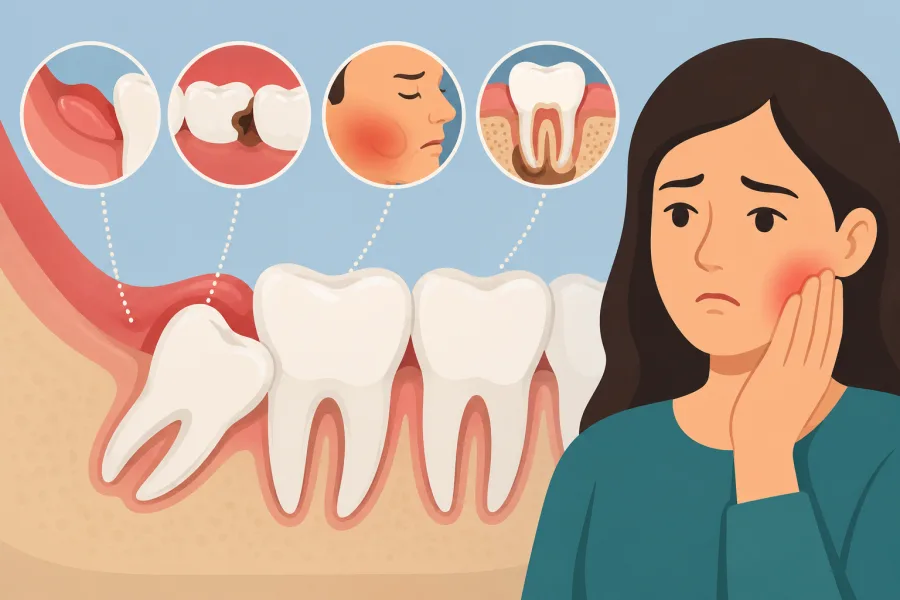
Leaving third molars in place when there is insufficient space in the dental arch carries progressive risks that compound each decade. Many patients assume that an absence of pain indicates healthy integration, but asymptomatic wisdom teeth frequently harbor silent pathology. As the jaw matures, the surrounding bone becomes significantly more rigid, making delayed intervention substantially more complex.
At Oral and Facial Surgery of Miami, board-certified oral and maxillofacial surgeon Dr. Johanny Caceres evaluates patients who have retained their third molars into adulthood. Understanding the biological domino effect triggered by unaddressed third molars helps individuals protect their surrounding teeth, bone structure, and long-term oral stability.
Chronic Pericoronitis and Soft Tissue Breakdown
When a wisdom tooth partially breaches the gumline, it creates a persistent flap of tissue known as an operculum. This anatomical fold forms an inaccessible reservoir where food debris, saliva, and aggressive anaerobic bacteria gather. Normal tooth brushing and flossing cannot reach beneath this tissue ledge, establishing a chronic bacterial breeding ground.
The resulting inflammation, termed pericoronitis, produces recurring episodes of localized pain, swelling, foul breath, and trismus (restricted jaw opening). If left untreated over several years, this low-grade infection compromises surrounding soft tissues and migrates toward deep fascial spaces in the neck, turning a simple dental inconvenience into a medical emergency requiring intravenous antibiotics and surgical drainage.
| Clinical Feature | Normal Erupted Molar | Retained Impacted Wisdom Tooth |
|---|---|---|
| Hygiene Access | Accessible for daily brushing and flossing | Severely restricted behind retro-molar pad |
| Periodontal Health | Healthy probing depths of 1 to 3 mm | Deep pockets exceeding 5 to 7 mm with bone loss |
| Second Molar Impact | Maintains normal physiological contact points | Causes root caries and external root resorption |
| Surgical Difficulty with Age | Not indicated for routine removal | Increases sharply due to bone density and ankylosis |
Second Molar Root Resorption and Cervical Cavities
One of the most destructive outcomes of retaining third molars is collateral damage to the neighboring second molars. When a third molar erupts at an angular or horizontal trajectory, its crown rests directly against the roots or the cervical neck of the second molar. This contact creates an un-cleanable biological niche where bacteria thrive undisturbed.
Over prolonged periods, bacteria erode the root surface of the second molar, producing deep cervical caries below the gumline. Even more alarming is pressure-induced external root resorption, where the body gradually dissolves the structural cementum and dentin of the second molar root. In numerous instances, by the time discomfort prompts an evaluation, both the wisdom tooth and the essential second molar must be extracted simultaneously.
Mandibular Cyst Formation and Structural Bone Loss
Every un-erupted tooth develops within a microscopic sac of tissue called a dental follicle. When a wisdom tooth remains completely embedded within the jawbone, this sac can fill with fluid, expanding into an odontogenic cyst such as a dentigerous cyst or keratocyst.
These cysts expand silently inside the jaw without initial pain, hollowing out the interior cortical and cancellous bone. As the cyst enlarges, it weakens the angle of the mandible, rendering the jaw susceptible to pathological fractures from minor trauma. Advanced cysts can also displace adjacent teeth and compress the inferior alveolar nerve, causing persistent numbness or paresthesia across the lower lip and chin.
Proactive Surgical Evaluation and Care at OFS Miami
Waiting for retained wisdom teeth to trigger symptoms frequently transforms a predictable preventative procedure into a complex reconstructive challenge. At our practice, Dr. Johanny Caceres uses advanced high-definition 3D Cone Beam Computed Tomography (CBCT) to map the exact spatial relationship between third molar roots, adjacent second molars, and vital nerve canals.
For patients requiring surgical removal, our state-of-the-art OFS Miami surgical center offers outpatient IV sedation to ensure complete comfort throughout treatment. Taking action before irreversible bone loss or root damage occurs preserves your natural dentition and avoids lengthy restorative procedures later in life.
Protect your dental health with an expert surgical evaluation. Call Oral and Facial Surgery of Miami today at (305) 552-1193 or schedule your appointment online today.