
Do You Need a Simple or Surgical Extraction?
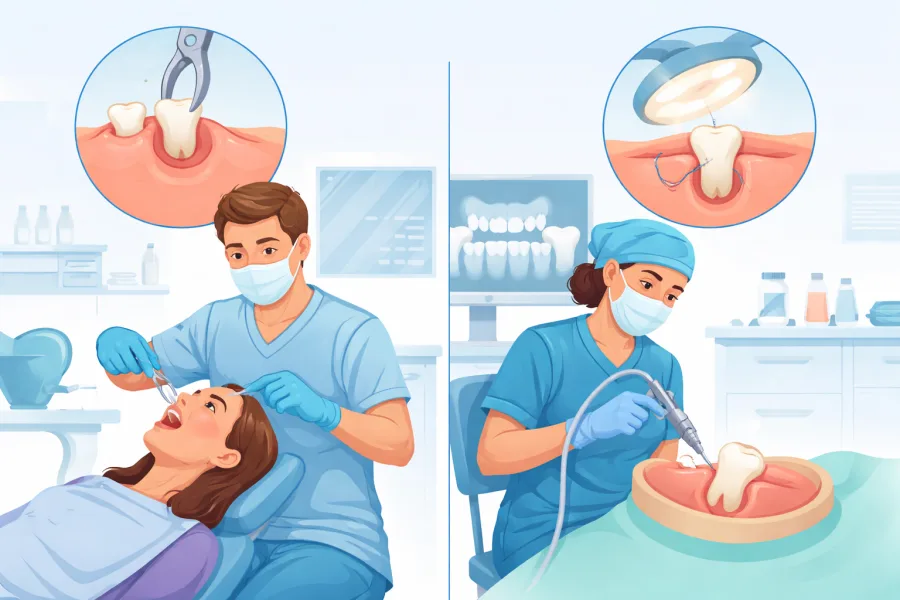
When a dental patient is informed that a tooth must be removed, hearing the distinction between a simple extraction and a surgical extraction can cause confusion and concern. Many patients assume that surgical extraction implies severe complications or an unusually painful procedure. In reality, the difference between these two treatment approaches is rooted in anatomical visibility, root morphology, and the surgical techniques required to remove the tooth safely without damaging surrounding bone.
At Oral and Facial Surgery of Miami, board-certified oral and maxillofacial surgeon Dr. Johanny Caceres performs both routine and complex tooth removals daily. Understanding the technical differences between simple and surgical extractions, evaluating bone preservation techniques, and knowing what to expect during recovery helps South Florida patients approach their procedures with clarity and peace of mind.
The Mechanics of a Simple Dental Extraction
A simple extraction is performed on a tooth that is fully erupted, clearly visible within the mouth, and has intact coronal structure that can be engaged firmly with dental instruments. General dentists and oral surgeons routinely perform simple extractions under local anesthesia. The clinician uses an elevator instrument to gently expand the alveolar socket and sever the microscopic periodontal ligament fibers holding the tooth root in place.
Once the tooth is loosened within the bone socket, extraction forceps apply controlled rotational and lateral forces to lift the tooth out in one piece. Because no surgical incisions are made into the gum tissue and no bone is removed, the procedure is swift, requires minimal post-operative instrumentation, and rarely necessitates sutures. Patients typically experience mild soreness that resolves within two to three days.
When a Tooth Removal Becomes a Surgical Extraction
A surgical extraction becomes necessary when a tooth cannot be easily accessed or removed using conventional forceps elevation. Common indications include teeth that have broken off below the gumline, deeply decayed roots, impacted third molars encased in bone, or teeth with curved, divergent, or hypercementosed roots. In these scenarios, attempting a simple extraction would risk fracturing root tips or crushing delicate alveolar bone plates.
During a surgical extraction, the surgeon reflects a small incision into the gum tissue to create a mucoperiosteal flap, exposing the underlying bone. If the tooth remains trapped, a specialized handpiece removes a minimal amount of overlying cortical bone. Often, the surgeon sections the tooth into smaller pieces, allowing each root segment to be delivered gently without excessive force. Once the roots are removed, the site is debrided, bone grafting is placed if planned, and dissolvable sutures are placed to close the gum tissue.
| Extraction Factor | Simple Extraction | Surgical Extraction |
|---|---|---|
| Tooth Visibility | Fully erupted and accessible above the gumline | Impacted, broken at gumline, or submerged in bone |
| Incision & Bone Removal | None; performed without gum flap or bone cutting | Requires small gum incision and minimal bone relief |
| Tooth Sectioning | Delivered intact in a single piece | Sectioned into root fragments to protect jawbone |
| Anesthesia Options | Primarily local anesthesia, optional nitrous oxide | Local anesthesia, IV twilight sedation, or general anesthesia |
Anesthesia, Sedation, and Patient Comfort Differences
While simple extractions are easily completed with local numbing injections, surgical extractions frequently benefit from advanced sedation. Removing impacted wisdom teeth or sectioning molar roots can cause audible vibration, pressure sensations, and elevated patient anxiety. Board-certified oral and maxillofacial surgeons maintain specialized certification to administer intravenous twilight sedation within their accredited surgical suites.
Under IV twilight sedation, patients fall into a peaceful sleep while breathing independently. You feel zero pain, hear no surgical sounds, and retain no stressful memory of the procedure. Multiparameter monitors continuously assess vital signs, providing hospital-grade safety standards that make even extensive multi-tooth surgical removals relaxed and comfortable.
Recovery and Restoration Planning in Coral Gables
Postoperative recovery differs slightly between the two procedures. A simple extraction involves minimal swelling and heals rapidly within three to five days. A surgical extraction involves a mild inflammatory response, with facial swelling peaking around forty-eight to seventy-two hours before receding. Over-the-counter anti-inflammatory medications and cold compresses easily control surgical discomfort.
At Oral and Facial Surgery of Miami, Dr. Johanny Caceres pairs surgical extractions with socket preservation bone grafting whenever a future dental implant is planned, ensuring your jawbone remains strong and stable. If you are facing a tooth extraction or need a consultation for impacted teeth, contact our surgical center at (305) 552-1193 or request an appointment online.