
Why Do We Have Wisdom Teeth? The Real Reason Behind Them
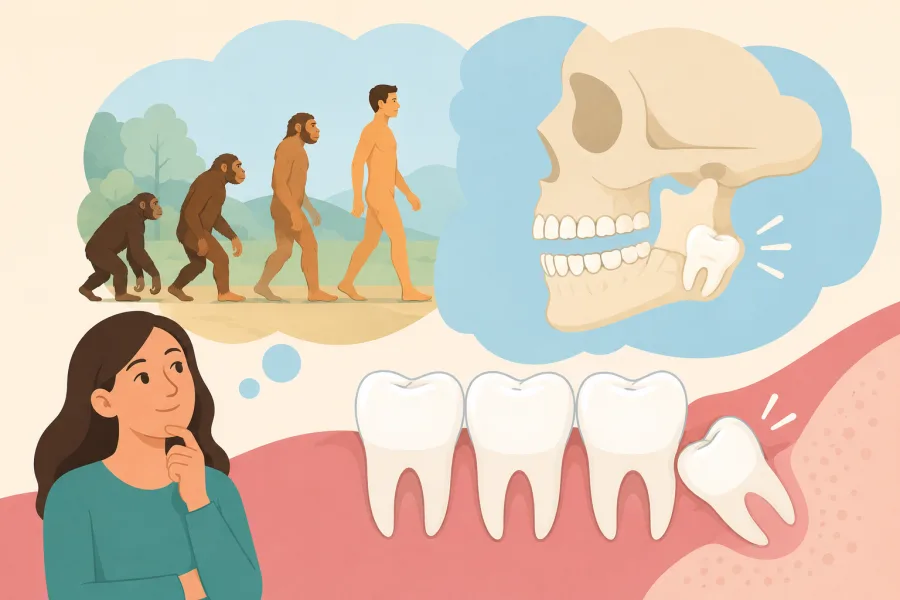
Third molars are the only permanent teeth that routinely cause so much disruption that their surgical removal is practically a cultural rite of passage. If the human body is the product of millions of years of anatomical refinement, why do we continue to develop teeth that so frequently become trapped, infected, or damaged? The answer lies at the intersection of evolutionary anthropology and modern dietary shifts.
At Oral and Facial Surgery of Miami, board-certified oral and maxillofacial surgeon Dr. Johanny Caceres combines surgical skill with a deep understanding of human craniofacial biology. Exploring the evolutionary origin of third molars clarifies why these vestigial teeth create complications in modern jaws and how specialized surgery preserves your health.
Evolutionary Origins: Ancestral Diets and Extra Chewing Power
Hundreds of thousands of years ago, early hominids survived on an unrefined, highly abrasive diet consisting of raw fibrous plants, tough roots, seeds, nuts, and uncooked meat. Chewing these coarse foods required immense masticatory bite force and extensive grinding surface area.
In our ancestors, third molars were vital functional tools. In addition, primitive diets laden with grit and sediment caused severe interproximal enamel wear, steadily reducing the width of each tooth over time. As teeth narrowed from constant abrasion, extra space opened naturally along the dental arch, allowing third molars to erupt cleanly and fill the rear of the jaw as valuable chewing replacements.
| Anatomical Feature | Early Hominids / Ancestral Humans | Modern Contemporary Humans |
|---|---|---|
| Primary Food Consistency | Raw coarse roots, fibrous vegetation, uncooked game | Cooked, processed, soft, calorically dense nutrition |
| Mandibular Jaw Size | Broad, elongated, robust alveolar bone ridges | Shorter, narrower, gracile facial architecture |
| Interproximal Enamel Wear | High friction created natural room for 32 teeth | Minimal tooth wear; full tooth widths maintained |
| Third Molar Eruption | Erupted upright and functioned as chewing molars | Impaction rates exceeding 70% due to lack of space |
The Shrinking Human Jaw: Agricultural Shifts and Dietary Softening
Over the past ten thousand years, the advent of agriculture, cooking, and food processing revolutionized human survival. As our ancestors learned to soften foods through boiling, milling, and baking, the heavy masticatory strain required to chew raw nourishment dropped drastically.
Bone growth in the jaw is stimulated by mechanical chewing stress during childhood. Because modern humans eat remarkably soft foods, our jaws do not receive the functional stimulation necessary to develop the broad, elongated dimensions of our ancestors. While our jaws evolved smaller and narrower, human genetics continues to program the development of all 32 permanent teeth, leaving third molars with insufficient space to emerge.
Why Modern Wisdom Teeth Cause Impaction and Dental Disease
Trapped inside a smaller jaw, third molars collide with the dense bone of the mandibular ramus or tilt forward into the roots of neighboring second molars. This mismatch results in varying degrees of bony and soft tissue impaction.
Partially erupted wisdom teeth leave an open gum flap (operculum) that gathers bacteria and causes recurrent pericoronitis infections. Completely buried teeth can trigger dentigerous cysts that hollow out jawbone from within. Because wisdom teeth no longer serve an evolutionary necessity, retaining them when space is deficient introduces serious risks of decay, periodontal disease, and structural damage.
Specialized Surgical Management and Comfort at OFS Miami
Understanding the evolutionary background of third molars clarifies why removal is so frequently necessary. At our practice, Dr. Johanny Caceres uses high-definition 3D Cone Beam CT scans to map the exact spatial orientation of your wisdom teeth relative to sensory nerves and bone boundaries.
our modern surgical center provides gentle outpatient IV twilight sedation, allowing you to rest peacefully while problem teeth are removed gently and accurately. Resolving evolutionary dental mismatches early protects your functional molars and secures lifelong oral health.
Concerned about how your wisdom teeth are developing? Call Oral and Facial Surgery of Miami today at (305) 552-1193 or book your 3D consultation online today.