
Why Wisdom Teeth Can Trigger Sinus Issues
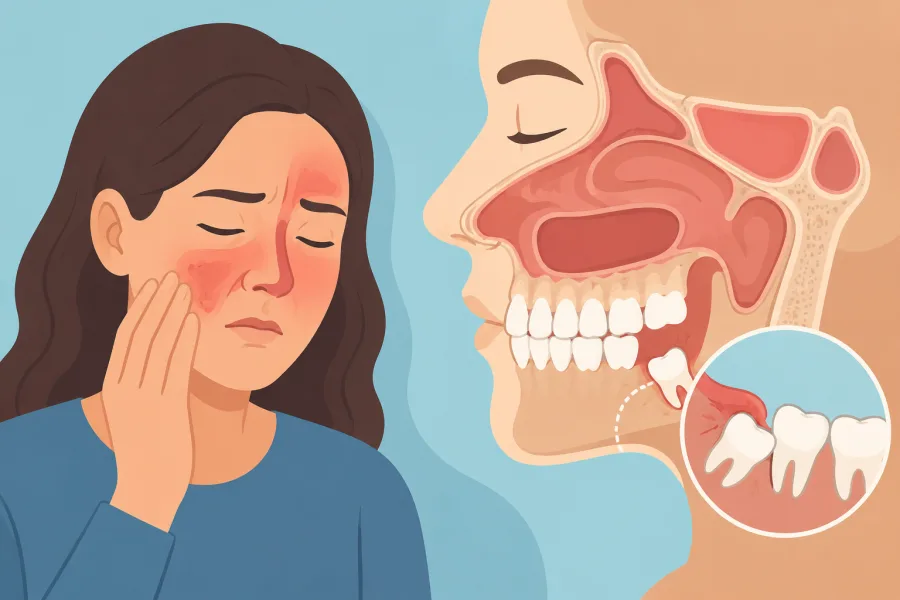
Undergoing surgical extraction of upper wisdom teeth (maxillary third molars) often introduces a unique set of post-operative sensations that lower extractions do not cause. Because the roots of upper wisdom teeth sit in intimate anatomical contact with the floor of the maxillary sinuses, patients frequently report unilateral nasal congestion, cheek fullness, or a sensation of air pressure following surgery. Distinguishing between normal post-surgical sinus inflammation and a genuine sinus complication is essential for peace of mind.
At Oral & Facial Surgery of Miami, board-certified oral and maxillofacial surgeon Dr. Johanny Caceres specializes in complex dentoalveolar surgery. Through meticulous pre-surgical 3D imaging and gentle minimally invasive surgical protocols, our practice minimizes sinus trauma and equips patients with clear guidelines for uneventful healing.
1. Post-Surgical Sinus Dynamics: Anatomy of the Maxillary Floor After Upper Extraction
The maxillary sinuses are large, air-filled cranial cavities situated directly above the upper premolars and molars. The bony floor separating the tips of upper wisdom tooth roots from the sinus cavity can be extraordinarily thin, often measuring less than a millimeter or existing solely as a paper-thin mucosal boundary (the Schneiderian membrane). Lower wisdom teeth, by contrast, are housed completely within the dense cortical bone of the mandible and have zero relationship with sinus cavities.
When an upper wisdom tooth is elevated and removed, the surrounding bony alveolus undergoes immediate inflammatory remodeling. Mild localized swelling naturally extends into the adjacent sinus mucosa, temporarily narrowing the natural drainage pathways of the sinus cavity. This produces a harmless feeling of cheek heaviness, light nasal stuffiness, or mild sinus pressure that typically peaks on the second or third day before resolving.
2. Normal Post-Operative Pressure vs. Oroantral Communication (OAC)
While mild stuffiness is a normal part of the inflammatory healing phase, a specific anatomical event known as an oroantral communication (OAC) can occur if a deeply embedded root tip was fused directly to the sinus lining. When such a tooth is extracted, a tiny micro-perforation may link the oral cavity directly to the maxillary sinus.
Small communications (measuring less than two millimeters) almost always heal spontaneously as a firm blood clot forms and primary mucosal tissue bridges the socket. However, larger openings require immediate surgical recognition and stabilization. Recognizing the classic signs of an active oroantral opening allows for timely management: you may notice an escape of air into your mouth when gently breathing, liquids passing into your nasal cavity when drinking, or an inability to generate suction when swallowing.
| Post-Operative Indicator | Expected Benign Sinus Response | Oroantral Communication / Infection |
|---|---|---|
| Pressure Sensation | Dull cheek fullness that peaks at 48 hours and fades by Day 5 | Persistent hollow whistle, air rushing sensation, or escalating throbbing pain |
| Nasal Discharge | Clear or faint pink tinged fluid on the operative side for 24 hours | Thick, discolored, foul-tasting, or bad-smelling purulent drainage |
| Drinking Liquids | Normal swallowing without nasal leakage | Liquids reflux unexpectedly through the nose when drinking |
| Oral Suction | Normal ability to create oral negative pressure | Inability to hold oral suction; air leaks into upper molar socket |
| Clinical Action | Rest, warm compresses after Day 3, routine follow-up | Immediate surgical evaluation, sinus precautions, and protective closure |
3. Essential Sinus Precautions Following Upper Wisdom Tooth Extraction
If your pre-operative 3D imaging reveals that your upper third molar roots extend into the sinus floor, Dr. Caceres will instruct you to observe strict sinus precautions for 10 to 14 days following surgery. These protocols are designed to prevent pressure changes from disrupting the blood clot inside the extraction socket:
- Do Not Blow Your Nose: If you feel congested, gently wipe drainage with a soft tissue. Forcible nose blowing creates intense positive pressure inside the sinus cavity, which can blow out the healing clot.
- Sneeze With Your Mouth Open: If you must sneeze, keep your mouth wide open. This releases the sneeze pressure through the oral airway rather than directing high-velocity air into the maxillary sinus.
- Avoid Suction and Negative Pressure: Never drink through straws, smoke, vape, or play brass musical instruments, as negative pressure pulls the blood clot down into the mouth.
- Avoid Heavy Bending or Lifting: Inverting your head increases cephalic hydrostatic pressure, straining the delicate Schneiderian membrane.
4. Specialist Surgical Management and Recovery in Coral Gables
Preventing sinus complications begins long before surgery starts. At Oral & Facial Surgery of Miami, Dr. Johanny Caceres utilizes 3D Cone Beam Computed Tomography (CBCT) to evaluate the exact millimeter proximity of your root tips to the sinus floor. When roots protrude into the sinus, Dr. Caceres employs specialized surgical sectioning techniques rather than forceful elevation, gently removing the tooth in small fragments to keep the sinus membrane completely intact.
If a large sinus opening is present due to pre-existing infection or cyst formation, Dr. Caceres immediately performs an advanced closure technique, such as placing a collagen matrix barrier, bone grafting materials, or advancing a buccal mucosal flap for watertight primary closure. Supported by targeted decongestants and prophylactic antibiotics, patients heal securely with zero long-term sinus sequelae.
If you are planning wisdom tooth extraction or are currently recovering from an upper molar removal and notice concerning sinus pressure or air passage, do not hesitate to contact our expert surgical team. Call Oral & Facial Surgery of Miami today at (305) 552-1193 or request your consultation online for specialized, reassuring Care at Oral & Facial Surgery of Miami.