
Can Wisdom Teeth Move Your Teeth Years Later?
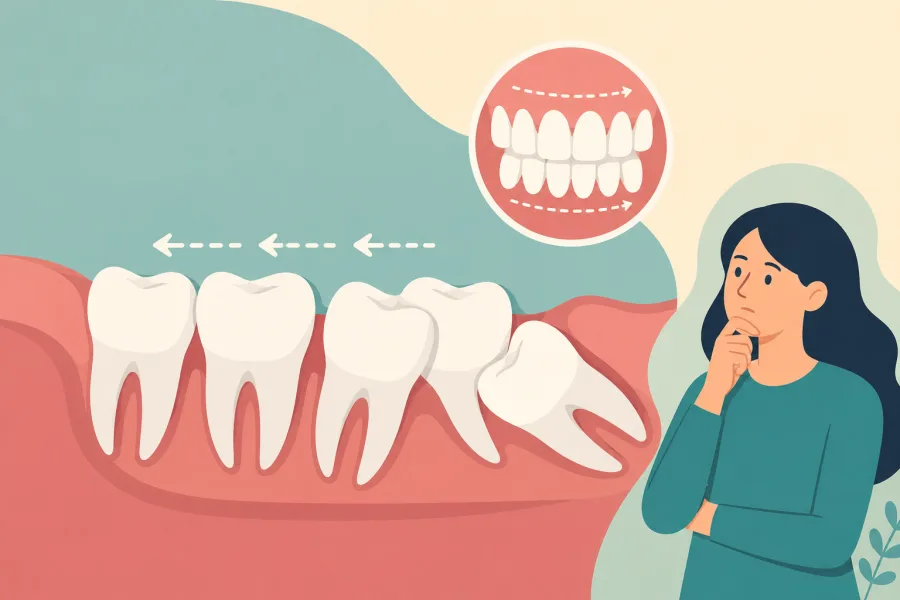
Few dental concerns create as much anxiety for adults as looking in the mirror and noticing that lower front teeth, once perfectly aligned by years of adolescent braces, have started to overlap. For decades, conventional wisdom placed the blame entirely on third molars. The common belief was that erupting wisdom teeth acted like biological bulldozers, shoving the entire dental arch forward and ruining orthodontic outcomes.
Modern craniofacial research and long-term clinical studies tell a far more nuanced story. While impacted third molars produce significant localized damage, they rarely possess enough force to single-handedly crowd your incisors years after the fact. At Oral and Facial Surgery of Miami in Coral Gables, Dr. Johanny Caceres regularly evaluates patients frustrated by late tooth movement to determine whether surgical extraction, orthodontic retention, or a combination of both provides the right solution.
1. The Biomechanics of Late Mandibular Crowding: Do Wisdom Teeth Really Push?
The theory that third molars generate an unstoppable forward pressure wave across fourteen intermediate teeth has been thoroughly evaluated by orthodontic and surgical researchers. Landmark clinical trials followed patients who had all four wisdom teeth removed alongside control groups who kept them, as well as individuals who were congenitally missing third molars from birth. The findings were decisive: late mandibular incisor crowding occurs at nearly identical rates in all three groups.
If wisdom teeth are not physically pushing front teeth out of line, what causes late crowding? The true culprits involve complex, lifelong biological dynamics:
- Physiological Mesial Drift: Human teeth possess an inherent biological tendency to migrate slowly toward the front midline of the jaw over a lifetime. This evolutionary mechanism once compensated for interproximal enamel wear caused by coarse ancestral diets, but in modern mouths with refined diets, it gradually closes arch perimeter.
- Late Mandibular Growth: The lower jaw does not stop subtle dimensional remodeling in your early twenties. Continued microscopic growth vectors in the mandible place the lower incisors in contact with the lingual surfaces of the upper front teeth, forcing the lower teeth to tilt, rotate, and overlap.
- Anterior Vector of Occlusal Force: Every time you bite and chew, your chewing muscles generate biting forces that naturally direct a forward vector through the contact points of your teeth.
- Perioral Soft Tissue Pressure: The constant resting tone and functional pressure of your lips and cheeks gradually overpower periodontal ligament support as collagen elasticity changes with age.
2. When Impacted Third Molars Cause Severe Localized Destruction
While third molars may be acquitted of single-handedly displacing your front teeth, they remain hazardous neighbors to the second molars directly in front of them. When a wisdom tooth becomes impacted horizontally or angularly, its physical position poses serious clinical dangers that require prompt intervention.
An impacted wisdom tooth pressing directly against the roots of a healthy second molar can trigger external root resorption. In this scenario, the cellular pressure activates osteoclasts and odontoclasts that literally dissolve the root structure of the neighboring molar. Because this process occurs painlessly beneath the gumline, patients often remain unaware until the second molar suffers irreversible structural loss.
In addition, partial impactions create an un-cleanable niche at the cementoenamel junction. Food particles and oral bacteria pack into the deep crevice between the crown of the wisdom tooth and the root surface of the second molar. This leads to deep cervical decay, localized bone loss, and recurrent pericoronitis infections. In these instances, removing the wisdom tooth is not about saving your smile aesthetics; it is about saving your functional adult chewing molars.
3. Shifting Teeth Management: Retention vs. Extraction Comparison
Understanding the distinct roles of orthodontic retention, surgical extraction, and clinical observation allows patients to address shifting teeth rationally rather than relying on outdated assumptions:
| Intervention Strategy | Primary Clinical Goal | Effect on Incisor Crowding | Effect on Posterior Health |
|---|---|---|---|
| Consistent Retainer Wear | Physical stabilization of the dental arch | 100% effective against drift and growth changes | Neutral; does not prevent impacted molar cysts or decay |
| Surgical Extraction | Eliminates localized impaction, cysts, and resorption | Minimal; does not stop physiological mesial drift | Protects second molar roots, bone levels, and gum health |
| Clear Aligner Re-treatment | Active realignment of crowded or rotated incisors | Corrects established aesthetic and functional relapse | Requires extraction first if molar distalization is planned |
| 3D CBCT Monitoring | Visualizes root proximity and bone architecture | Diagnostic only; tracks progressive changes | Identifies subclinical root damage before symptoms emerge |
4. Chairside Evaluation with Dr. Johanny Caceres in Coral Gables
If you notice your teeth shifting years after orthodontic treatment, blaming your wisdom teeth without diagnostic imaging often leads to the wrong treatment choice. Removing third molars will not magically straighten crowded front teeth once they have slipped their contacts, nor will clear aligners protect a second molar that is currently being eroded by an impacted third molar.
At our practice, Dr. Johanny Caceres conducts comprehensive clinical evaluations utilizing low-radiation cone-beam 3D computed tomography (CBCT). This imaging provides a crystal-clear volumetric view of your jaw anatomy:
- Precise angulation of each third molar relative to the dental arch
- Exact three-dimensional distance from the inferior alveolar nerve canal
- Integrity of the cortical bone and root structure of adjacent second molars
- Assessment of the periodontal ligament spaces and presence of follicular cysts
Whether your situation calls for preventive surgical extraction under gentle outpatient IV sedation or coordination with your orthodontist for retainer replacement, our Coral Gables surgical team ensures you receive an honest, biologically sound diagnosis. Contact Oral and Facial Surgery of Miami at (305) 552-1193 or book your consultation online to protect your smile for the decades ahead.